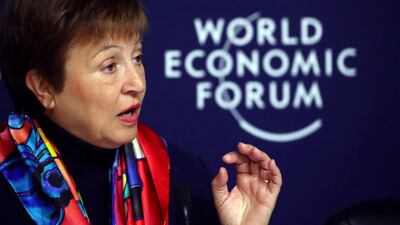
The year ahead will be like "navigating an obstacle course" warns IMF managing director Kristalina Georgieva. Reuters

IMF's Kristalina Georgieva: 2022 'even more difficult than 2020' for global economy


Alice Haine
  • English
  • Arabic

International Monetary Fund chief Kristalina Georgieva said on Friday that 2022 will be an even more difficult for the global economy than 2020, with conditions varying wildly between countries.

Ms Georgieva told delegates attending the virtual World Economic Forum that countries must be flexible and data driven in their approach to the challenges ahead, as economies across the world grapple with high inflation, the continuing Covid-19 crisis and resulting supply chain disruption and high debt levels.

“2022 is like navigating an obstacle course, with all the risks of inflation, Covid continuing and high debt levels,” Ms Georgieva said during a virtual panel of the WEF.

“Pandemic policy remains a top economic policy in 2022. Unless we build protections around the globe, we will continue to see disruption and the future will not be as bright as we want, so, we have to recognise that the world must spend the billions necessary to contain Covid in order to gain trillions in output as a result.”

While Ms Georgieva expects the global economic recovery to continue in 2022, she said it was “losing some momentum” because of the rise in Covid-19 infections, in addition to “much more persistent than anticipated inflation”, and record high of debt levels.

Global debt soared to $226 trillion in 2020, the largest 12-month debt surge since the Second World War, as the Covid-19 pandemic plunged the world economy into its deepest recession since the 1930s.

Ms Georgieva said the IMF needed to understand why inflation is more persistent in some countries than others, with any approach to tackle it undertaken not just by central banks but also policymakers.

Inflation in the US jumped to 7 per cent in December from a year earlier, the highest inflation rate since 1982 and the latest evidence that rising costs for food, rent and other necessities are heightening the financial pressures on US households.

In the UK, the picture was equally bleak with inflation hitting 5.4 per cent in December — its highest reading since 1992 — as the country heads into a cost-of-living crisis for British households amid higher energy prices and taxes.

Ms Georgieva said higher inflation is driven by demand surging amid global supply chain disruption caused by the “waves of Covid still with us”, while food prices are also shooting up amid climate change challenges and higher energy prices.

With some countries also facing labour market issues, such as the UK where unemployment has fallen to 4.1 per cent but vacancies have risen to a record 1.25 million, putting pressure on wages, central banks and other policymakers must both act to face this challenge, she said, including through boosting vaccinations to end the Covid-9 pandemic

“Unfortunately, this is still not quite where it should be. We have 86 countries where the target of at least 40 per cent vaccinations has not been met,” Ms Georgieva said.

“If you compare Sub Saharan Africa to advanced economies, vaccinations are at 7 per cent compared to 70 per cent in advanced economies. Obviously this also has significance for supply chain disruptions, and it has significance for this very dangerous divergence that we're seeing in the world economy.”

With inflation high in some countries and low in others, Ms Georgieva said it is time to recognise the complexity of the challenges ahead as well as the fact inflation is now country specific.

“That is what makes our job in 2022 even more difficult than 2020,” she said.

“While in 2020, we had similar policies everywhere, because we were fighting the same problem — an economy in a standstill. In 2022, conditions in countries are very different so cannot any more have the same policy everywhere any more. It has to be country specific.”

European Central Bank president Christine Lagarde agreed that inflation conditions are very different in the eurozone compared with other advanced economies.

Despite the eurozone’s inflation rate hitting a record high in December of 5 per cent as the economy came under renewed stress amid surging Omicron infections, tighter restrictions and higher energy prices, Ms Lagarde said prices are unlikely to surge to the levels seen in the US.

The ECB’s monetary policy has come under the spotlight in recent weeks with the central bank considered behind its British and American counterparts when it comes to its normalisation path.

But Ms Lagarde said the 19 countries sharing the euro, which recently celebrated its 20-year anniversary, did not share the US’s “state of excessive demand” which is now 30 per cent above pre-pandemic levels.

Instead the eurozone is “just about at pre-pandemic levels” Ms Lagarde said, while the economic bloc’s labour market is not facing “The Great Resignation” seen elsewhere, “and our employment participation numbers are getting very close to the pre-pandemic level,” she added.

“So I think those two factors, if you look at them carefully, are clearly indicating that we’re not moving at the same speed, and we’re unlikely to experience the same kind of inflation increases that the US market has faced.”

Ms Georgieva said earlier this week that she expects the IMF to raise its forecast that the Covid-19 pandemic will cost the global economy $12.5 trillion through 2024, as huge gaps in vaccine rates and the overall widening divergence between rich and poor caused by the pandemic, along with learning losses and increased gender impacts, would cause more protests, tensions and insecurity.

Ms Lagarde meanwhile said that Europe had been “victims of our own success,” whether scientific success enabling the fast vaccination roll-out or the success of monetary and fiscal policies working hand-in-hand to avoid the scarring and layoffs that would have happened otherwise.

While Ms Lagarde acknowledged that the “staggering” demand recovery had caused challenges such as a lack of lorry drivers and backlogged ports, her outlook was more upbeat.

With wage negotiations “not being way up yet,” Ms Lagarde said the ECB was not seeing a sustainable movement in prices that could lead to inflation “spiralling out of control".

“On the contrary, we assume for the moment that energy prices will stabilise in the course of 2022, and that bottlenecks will also stabilise, and gradually those inflation numbers will decline,” she told the panel.


Mercer, the investment consulting arm of US services company Marsh & McLennan, expects its wealth division to at least double its assets under management (AUM) in the Middle East as wealth in the region continues to grow despite economic headwinds, a company official said.

Mercer Wealth, which globally has $160 billion in AUM, plans to boost its AUM in the region to $2-$3bn in the next 2-3 years from the present $1bn, said Yasir AbuShaban, a Dubai-based principal with Mercer Wealth.

Within the next two to three years, we are looking at reaching $2 to $3 billion as a conservative estimate and we do see an opportunity to do so,” said Mr AbuShaban.

Mercer does not directly make investments, but allocates clients’ money they have discretion to, to professional asset managers. They also provide advice to clients.

“We have buying power. We can negotiate on their (client’s) behalf with asset managers to provide them lower fees than they otherwise would have to get on their own,” he added.

Mercer Wealth’s clients include sovereign wealth funds, family offices, and insurance companies among others.

From its office in Dubai, Mercer also looks after Africa, India and Turkey, where they also see opportunity for growth.

Wealth creation in Middle East and Africa (MEA) grew 8.5 per cent to $8.1 trillion last year from $7.5tn in 2015, higher than last year’s global average of 6 per cent and the second-highest growth in a region after Asia-Pacific which grew 9.9 per cent, according to consultancy Boston Consulting Group (BCG). In the region, where wealth grew just 1.9 per cent in 2015 compared with 2014, a pickup in oil prices has helped in wealth generation.

BCG is forecasting MEA wealth will rise to $12tn by 2021, growing at an annual average of 8 per cent.

Drivers of wealth generation in the region will be split evenly between new wealth creation and growth of performance of existing assets, according to BCG.

Another general trend in the region is clients’ looking for a comprehensive approach to investing, according to Mr AbuShaban.

“Institutional investors or some of the families are seeing a slowdown in the available capital they have to invest and in that sense they are looking at optimizing the way they manage their portfolios and making sure they are not investing haphazardly and different parts of their investment are working together,” said Mr AbuShaban.

Some clients also have a higher appetite for risk, given the low interest-rate environment that does not provide enough yield for some institutional investors. These clients are keen to invest in illiquid assets, such as private equity and infrastructure.

“What we have seen is a desire for higher returns in what has been a low-return environment specifically in various fixed income or bonds,” he said.

“In this environment, we have seen a de facto increase in the risk that clients are taking in things like illiquid investments, private equity investments, infrastructure and private debt, those kind of investments were higher illiquidity results in incrementally higher returns.”

The Abu Dhabi Investment Authority, one of the largest sovereign wealth funds, said in its 2016 report that has gradually increased its exposure in direct private equity and private credit transactions, mainly in Asian markets and especially in China and India. The authority’s private equity department focused on structured equities owing to “their defensive characteristics.”

The winners

Fiction

  • ‘Amreekiya’  by Lena Mahmoud
  •  ‘As Good As True’ by Cheryl Reid

The Evelyn Shakir Non-Fiction Award

  • ‘Syrian and Lebanese Patricios in Sao Paulo’ by Oswaldo Truzzi;  translated by Ramon J Stern
  • ‘The Sound of Listening’ by Philip Metres

The George Ellenbogen Poetry Award

  • ‘Footnotes in the Order  of Disappearance’ by Fady Joudah

Children/Young Adult

  •  ‘I’ve Loved You Since Forever’ by Hoda Kotb 
6 UNDERGROUND

Director: Michael Bay

Stars: Ryan Reynolds, Adria Arjona, Dave Franco

2.5 / 5 stars

Our legal consultant

Name: Dr Hassan Mohsen Elhais

Position: legal consultant with Al Rowaad Advocates and Legal Consultants.

MATCH INFO

Tottenham 4 (Alli 51', Kane 50', 77'. Aurier 73')

Olympiakos 2 (El-Arabi 06', Semedo')

UAE currency: the story behind the money in your pockets
Skoda Superb Specs

Engine: 2-litre TSI petrol

Power: 190hp

Torque: 320Nm

Price: From Dh147,000

Available: Now

The Ashes

Results
First Test, Brisbane: Australia won by 10 wickets
Second Test, Adelaide: Australia won by 120 runs
Third Test, Perth: Australia won by an innings and 41 runs
Fourth Test: Melbourne: Drawn
Fifth Test: Australia won by an innings and 123 runs

Defence review at a glance

• Increase defence spending to 2.5% of GDP by 2027 but given “turbulent times it may be necessary to go faster”

• Prioritise a shift towards working with AI and autonomous systems

• Invest in the resilience of military space systems.

• Number of active reserves should be increased by 20%

• More F-35 fighter jets required in the next decade

• New “hybrid Navy” with AUKUS submarines and autonomous vessels

Pots for the Asian Qualifiers

Pot 1: Iran, Japan, South Korea, Australia, Qatar, United Arab Emirates, Saudi Arabia, China
Pot 2: Iraq, Uzbekistan, Syria, Oman, Lebanon, Kyrgyz Republic, Vietnam, Jordan
Pot 3: Palestine, India, Bahrain, Thailand, Tajikistan, North Korea, Chinese Taipei, Philippines
Pot 4: Turkmenistan, Myanmar, Hong Kong, Yemen, Afghanistan, Maldives, Kuwait, Malaysia
Pot 5: Indonesia, Singapore, Nepal, Cambodia, Bangladesh, Mongolia, Guam, Macau/Sri Lanka

Semi-final fixtures

Portugal v Chile, 7pm, today

Germany v Mexico, 7pm, tomorrow

Updated: January 23, 2022, 3:51 AM